
Tony Jannus and the First Scheduled Commercial Flight

A 23-Minute Hop Across Tampa Bay That Changed the World
By Joe Marzo
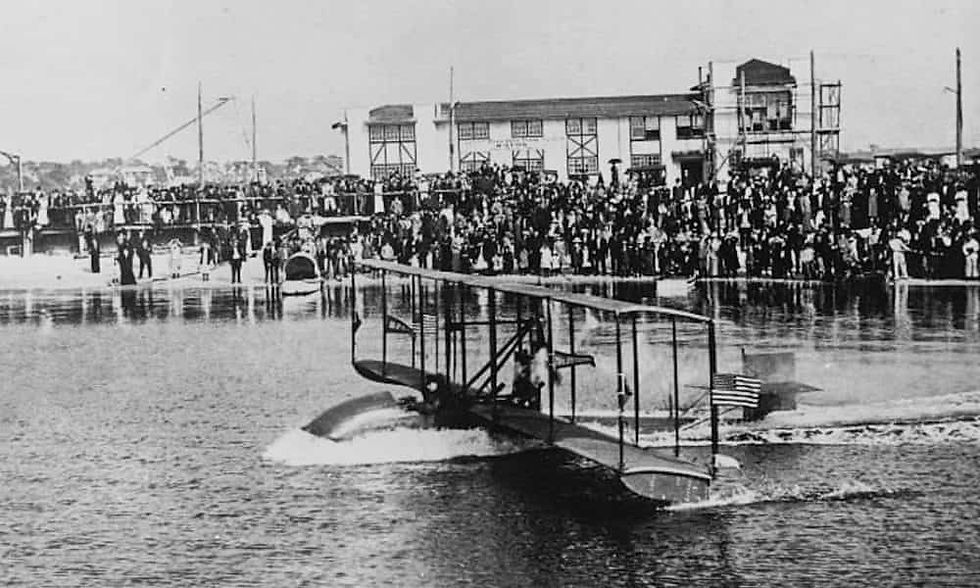
On the bright, cool morning of January 1, 1914, a crowd estimated at somewhere between two and three thousand people pressed against the railings of the wooden municipal pier in downtown St. Petersburg, Florida. They had come for a New Year's Day spectacle — a band concert, an auction, and, just after ten o'clock, the takeoff of a strange wooden contraption that one local newspaper had described as "a motor boat with wings and an air propeller."
At the controls sat a slender, dark-haired twenty-four-year-old named Antony Habersack Jannus. Beside him sat Abram C. Pheil, the former mayor of St. Petersburg, who had paid four hundred dollars at auction — more than eleven thousand in today's money — for the privilege of becoming the first paying passenger on the first scheduled commercial airline flight in human history.
The little Benoist Type XIV flying boat slid down a greased wooden ramp into Tampa Bay, taxied out into open water, and lifted into the sky. Twenty-three minutes and roughly twenty-one miles later, Jannus set it down on the Hillsborough River in downtown Tampa, where another crowd of two thousand waited cheering on the riverbank. Commercial aviation, as the world would come to know it, had begun.
The Pilot
Tony Jannus was not, in 1914, an obscure figure. He was already one of the most famous American aviators of the pre–World War I era — a daredevil-playboy pilot, in the words of one historian, whose looks, easy charm, and willingness to attempt almost anything in an airplane had made him front-page news up and down the Mississippi Valley and the East Coast.
Born in Washington, D.C., on July 22, 1889, into a comfortable family — his father was a patent attorney, his grandfather a former politician — Jannus spent his early twenties as a boat-engine mechanic before attending an air show in Baltimore in November 1910 and falling instantly under the spell of aviation. He essentially taught himself to fly, soloing in a Rexford Smith biplane at College Park Airport in Maryland later that same year. He was a natural. By 1911 he and his older brother Roger had been hired as test pilots by Thomas W. Benoist, a St. Louis aircraft manufacturer who was one of the most innovative builders in the country.
In the years that followed, Jannus collected firsts the way some young men collected speeding tickets. On March 1, 1912, with Jannus at the controls of a Benoist biplane fitted with floats, the parachutist Albert Berry stepped off into open air at fifteen hundred feet — the first parachute jump ever made from a powered airplane. Later that year, Jannus piloted a Benoist flying boat from Omaha, Nebraska, down the Missouri and Mississippi rivers all the way to New Orleans, a journey of nearly two thousand miles, giving thousands of river-town residents their first glimpse of an airplane. He flew exhibitions in the Midwest, tested military aircraft, and raced over New York City. The New York Times praised his grace at the stick. Women — many of them — pursued him. He was twenty-four years old.
The Idea
The flight that would make Jannus permanently famous, however, was the brainchild not of a pilot but of a salesman. Percival Elliott Fansler was a Jacksonville-based sales representative for a manufacturer of diesel marine engines. He had been following Thomas Benoist's experiments with flying boats and had concluded that the airplane could be more than a novelty. It could be a business.
The Tampa Bay region in 1913 was a perfect laboratory for the idea. St. Petersburg and Tampa sat on opposite sides of a wide bay, separated as the crow flies by only about twenty miles, but in practical terms they were nearly a day apart. There was no bridge across the bay. A trip from one city to the other took roughly two hours by passenger steamer (when the weather cooperated), four to six hours by an indirect rail route that ran far inland around the head of the bay, or up to twelve hours by automobile over unpaved and uncertain roads. A St. Petersburg businessman who needed to spend a morning in Tampa would lose an entire day to the journey.
Fansler wrote to Benoist with a proposition: build two flying boats and supply pilots, and Fansler would organize a passenger airline between the two cities. Benoist agreed. Fansler then approached the St. Petersburg Board of Trade and persuaded local boosters, led by L. A. Whitney and Noel Mitchell, to subsidize the operation. The city agreed to put up roughly twenty-four hundred dollars in seed money to cover hangars and operating expenses, with an additional bonus contingent on minimum passenger loads. The contract was signed on December 17, 1913 — ten years almost to the day after the Wright brothers' first powered flight at Kitty Hawk.
The Aircraft
Benoist sent down two of his Type XIV flying boats, named Lark of Duluth and Florida. They were not glamorous machines. Each was about twenty-six feet long with a forty-four-foot wingspan, built mostly of spruce and linen, weighing only about 1,250 pounds empty, powered by a 75-horsepower Roberts engine driving a pusher propeller behind the pilot.
There was no cabin and no windshield. Pilot and passenger sat side by side in an open cockpit just above the water, with the bay air rushing past their faces. The aircraft cruised at perhaps sixty miles per hour, occasionally touching seventy-five. Jannus typically flew the route at well under fifty feet of altitude — low enough that, as one observer noted, passengers could practically reach down and touch the bay's surface.
The Inaugural Flight
The first flight, on New Year's Day 1914, was an event St. Petersburg had been promoting for weeks. A parade marched down to the waterfront. A band played. The mayor delivered remarks. The ticket auction produced its winning bid — Pheil's $400 — and at about ten in the morning Jannus and his passenger climbed aboard. The Lark of Duluth slid into the bay, taxied out, lifted off, and set a course northeast across open water for the mouth of the Hillsborough River.
Twenty-three minutes later they were down. The Tampa Tribune reported the next day that "a crowd of two thousand was waiting" and that "Messrs. Jannus and Pheil bowed and smiled." A St. Petersburg editorial waxed poetic: "Man has conquered the elements, the last element to be brought under subjugation being the air. Yesterday demonstrated the fact that air lines will in the very near future be used for transit purposes."
The regular schedule began at once. Flights departed St. Petersburg daily except Sundays at 10:00 a.m. and 2:00 p.m., with return flights leaving Tampa at 11:00 a.m. and 3:00 p.m. The standard one-way fare settled at five dollars. Every seat, Jannus liked to joke, was a window seat. Passengers occasionally got wet when spray came over the bow during takeoff, and on more than one occasion Jannus had to set the airboat down on the bay to make a quick mechanical repair before continuing on. Over the next three months, the Lark of Duluth and Florida together carried 1,205 paying passengers and logged more than eleven thousand miles in the air without serious injury to a single soul.
The End and the Legacy
The St. Petersburg–Tampa Airboat Line was always meant to be seasonal, timed to coincide with the winter tourist trade. When the original contract ran out and the city subsidy ended on March 31, 1914, the operation closed. Jannus moved on to other adventures — barnstorming, exhibition flying, and eventually a contract to deliver and demonstrate Curtiss flying boats to the Imperial Russian Navy.
He never returned to Florida. On October 12, 1916, while training Russian pilots in a Curtiss H-7 flying boat over the Black Sea, Jannus suffered engine failure and went into the water. His two Russian passengers, strapped into their seats, were recovered. Tony Jannus's body was not. He was twenty-seven years old.
The airline he had piloted into existence, brief and modest as it was, had proved something the world had not previously known for certain: that paying passengers, on a published schedule, could be carried through the air for profit. Every airline that came after — Pan American, KLM, Delta, every carrier in the sky today — traces its lineage back to that twenty-three-minute hop across Tampa Bay on New Year's Day, 1914. The Tony Jannus Distinguished Aviation Society, founded in 1964, has presented the annual Tony Jannus Award to the leading figures of commercial aviation ever since. A replica of the Lark of Duluth hangs in the St. Petersburg Museum of History, one hundred yards from the spot where the original slid into the water.
Tony Jannus has no grave. The bay he flew across has him still.


