The New Deal in Tampa: How Federal Dollars Rebuilt the Cigar City

By Joe Marzo

When Franklin D. Roosevelt took office in March 1933, Tampa was already several years into hard times. Florida's land boom had collapsed in 1926, well before the rest of the country plunged into the Great Depression, and the cigar industry — Tampa's economic engine — was reeling from declining demand and labor unrest. By the time the New Deal arrived in Florida, roughly one in four Floridians was on some form of public relief, and Mayor Robert E. Lee Chancey had already slashed the police and fire budgets and borrowed heavily just to keep the city running.
What followed over the next decade was one of the most transformative bursts of public construction in Tampa's history. Federal agencies created by Roosevelt's New Deal — the Works Progress Administration (WPA), the Public Works Administration (PWA), the Civil Works Administration (CWA), and others — poured millions of dollars into Tampa's streets, parks, schools, and public buildings. Many of those projects are still in daily use today, often without residents realizing they are walking, driving, or flying through eighty-year-old federal infrastructure.
A City on the Brink
Tampa entered the 1930s in a peculiarly Floridian kind of trouble. The collapse of the mid-decade real estate bubble had already shuttered banks, foreclosed hotels, and gutted construction jobs across the state. Tourism, which had partially insulated parts of Florida from earlier downturns, dropped from three million annual visitors to roughly one million as the Depression deepened. In Tampa specifically, the cigar industry — centered in Ybor City and West Tampa — was contracting fast, and the city government was cutting back rather than building.
Mayor Chancey, elected in 1931, took a hatchet to the budget, slashing roughly $100,000 from public safety alone. To keep the lights on, the city eventually borrowed $750,000 from the federal Reconstruction Finance Corporation — money that, importantly, would later help fund the local match required to draw down WPA project dollars. When Roosevelt's relief programs began flowing south in 1933 and 1934, Tampa was both desperate and unusually well-positioned to take advantage of them.
Bayshore Boulevard: The Crown Jewel
If there is a single New Deal project that defines modern Tampa, it is Bayshore Boulevard. The 6.5-mile sweep of seawall and sidewalk along Hillsborough Bay — long claimed to be the world's longest continuous sidewalk — exists in its current form because of the WPA.
The first allotment for Bayshore work, $248,689, was approved on November 4, 1935. Over the next three years, crews replaced the entire seawall along the boulevard, laid new and much wider pavement, and finally closed the missing link between the Platt Street Bridge and Magnolia Street. The total cost reached approximately $1.2 million — an enormous sum for a single municipal project in the 1930s. The work was largely necessary because the original seawall, built less than a decade earlier, had already begun to fail.
Today, Bayshore is one of Tampa's signature public spaces — a place for joggers, cyclists, and the annual Gasparilla parade. Almost every step of it sits on New Deal masonry.
Two Airports Built Out of the Depression
Tampa's modern aviation infrastructure also has deep New Deal roots. Two airports — Peter O. Knight Airport on Davis Islands and what would eventually become Tampa International — were both built with federal relief dollars in the same decade.
Peter O. Knight Airport opened in 1935 as a WPA project, named for the prominent Tampa attorney and Tampa Electric Company executive who had been instrumental in advocating for its construction. The WPA funded approximately $105,343 of the work, which included a seaplane basin alongside the runways. The original administration building was an event in itself, featuring a restaurant and a dance floor; both Eastern and National Airlines used the facility as Tampa's main commercial airport from 1935 until 1946. Although that original administration building was demolished in the 1960s and replaced, the airport itself remains in active use today as a general aviation field.
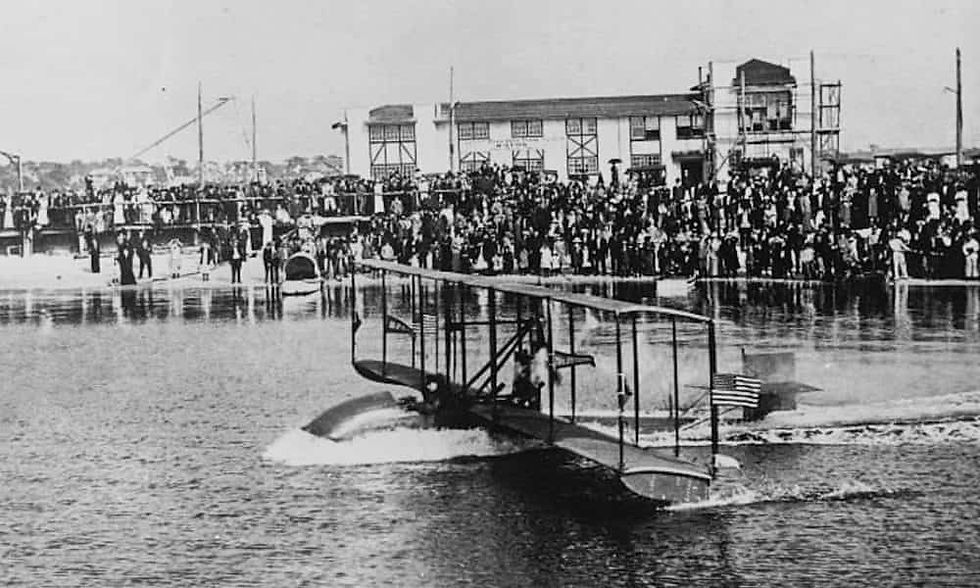
The airport's famous murals also came from the New Deal era. In 1939, local artist George Snow Hill was commissioned under New Deal sponsorship to paint seven works for Peter O. Knight, depicting the history of flight from Icarus and Daedalus through the Wright Brothers and Tampa's own Tony Jannus, who piloted the world's first scheduled airline flight across Tampa Bay in 1914. The murals were eventually removed and now hang in the Airside E Terminal at Tampa International Airport.
Drew Field — the predecessor to Tampa International — followed a similar arc. The city had leased the original 160-acre tract since 1928, but its lease lapsed during the Depression. In February 1934, Tampa purchased the land outright for $11,654 and immediately began work as a CWA project, with $31,000 in initial federal funds. A $46,000 WPA allotment followed in August 1935, and additional funding from the Civil Aeronautics Association extended the work over several years. By 1938, Drew Field had three 7,000-foot asphalt runways, full lighting, and a reputation as one of the best airfields in Florida. Without that New Deal foundation, Drew Field would not have been ready when the Army leased it in 1940 — and the modern Tampa International Airport, which grew out of the wartime base, might have followed a very different trajectory.
Reviving the Tampa Bay Hotel
Henry Plant's exuberant Moorish Revival hotel, with its distinctive silver minarets along the Hillsborough River, had been the symbol of Tampa's Gilded Age. By the early 1930s, however, the building stood largely empty after a tourism collapse forced its closure in 1931.
In 1933, the University of Tampa moved into the structure, and the WPA funded extensive restoration work to convert the aging hotel into functional academic space.
Plant Hall, as it is now known, anchors the University of Tampa campus today and houses the Henry B. Plant Museum. The WPA also spent approximately $186,000 improving Plant Park, the surrounding green space along the river — funding that, in 2025 dollars, would represent a multimillion-dollar civic investment.
Parks, Schools, and Civic Spaces
The list of smaller WPA projects scattered throughout Tampa is long, and many of them still serve their original purpose. Cuscaden Park, in Ybor City, was constructed by the WPA in 1935 and remains a neighborhood anchor. The Florida State Fairgrounds received approximately $465,000 in WPA spending for new buildings and improvements during the Depression years. Hillsborough High School, originally built in 1927, finally got its long-delayed gymnasium and athletic track during the New Deal era after Depression-era funding shortfalls had halted construction.
The Fort Homer W. Hesterly Armory in West Tampa, completed during this period in an Art Deco style, would go on to host an extraordinary parade of cultural figures over the following decades — Elvis Presley, John F. Kennedy, Martin Luther King Jr., James Brown, the Doors, and Pink Floyd among them — before being converted in recent years to the Tampa Jewish Community Center & Federation.
Beyond Bricks and Mortar
The New Deal's footprint in Tampa extended past physical infrastructure. The Federal Emergency Relief Administration (FERA) operated work programs and college aid initiatives in Florida. The Civilian Conservation Corps (CCC), while based largely at rural camps, employed roughly 49,000 Floridians during its lifespan and contributed to state parks and forests within driving distance of Tampa. The WPA's Federal Writers' Project employed researchers and writers across Florida — including author Zora Neale Hurston — producing guidebooks, oral histories, and cultural documentation that remain valuable historical records.
Federal investment also helped revive Tampa's banking sector and stabilize cigar industry employment, even as the long-term decline of hand-rolled cigars continued. By 1939, Florida had received approximately $32 million in PWA funding alone for 232 infrastructure projects — equivalent to more than half a billion dollars in current value — with a meaningful share landing in and around Tampa.
A Lasting Legacy
The New Deal's imprint on Tampa is hiding in plain sight. The seawall along Bayshore, the runways at Peter O. Knight, the foundations of Tampa International, the bones of Plant Hall at the University of Tampa, neighborhood parks in Ybor City — all of these are everyday parts of the city that exist because, in the depths of the Great Depression, the federal government chose to put unemployed Floridians to work building lasting public assets.
It is worth remembering, too, that this transformation was not universally celebrated at the time. Florida's business community was often skeptical of the New Deal's support for organized labor, and the state was the last in the South to adopt unemployment insurance under the Social Security Act. Yet the physical legacy that survived those political fights has outlasted them by nearly a century. When Tampa residents walk along the bay, fly out of TPA, or attend a class at the University of Tampa, they are using infrastructure that began as a Depression-era jobs program — a reminder that the city's modern identity was built, quite literally, by the New Deal.